


Last week at dinner, the conversation shifted to Universal Basic Income (UBI): Are we building systems to help people keep up, or to pay them to get out of the way?
Someone referred to it as the permanent underclass. The conversation got quiet because this outcome is plausible, and many believe it is probable.
Tech moves in platform shifts
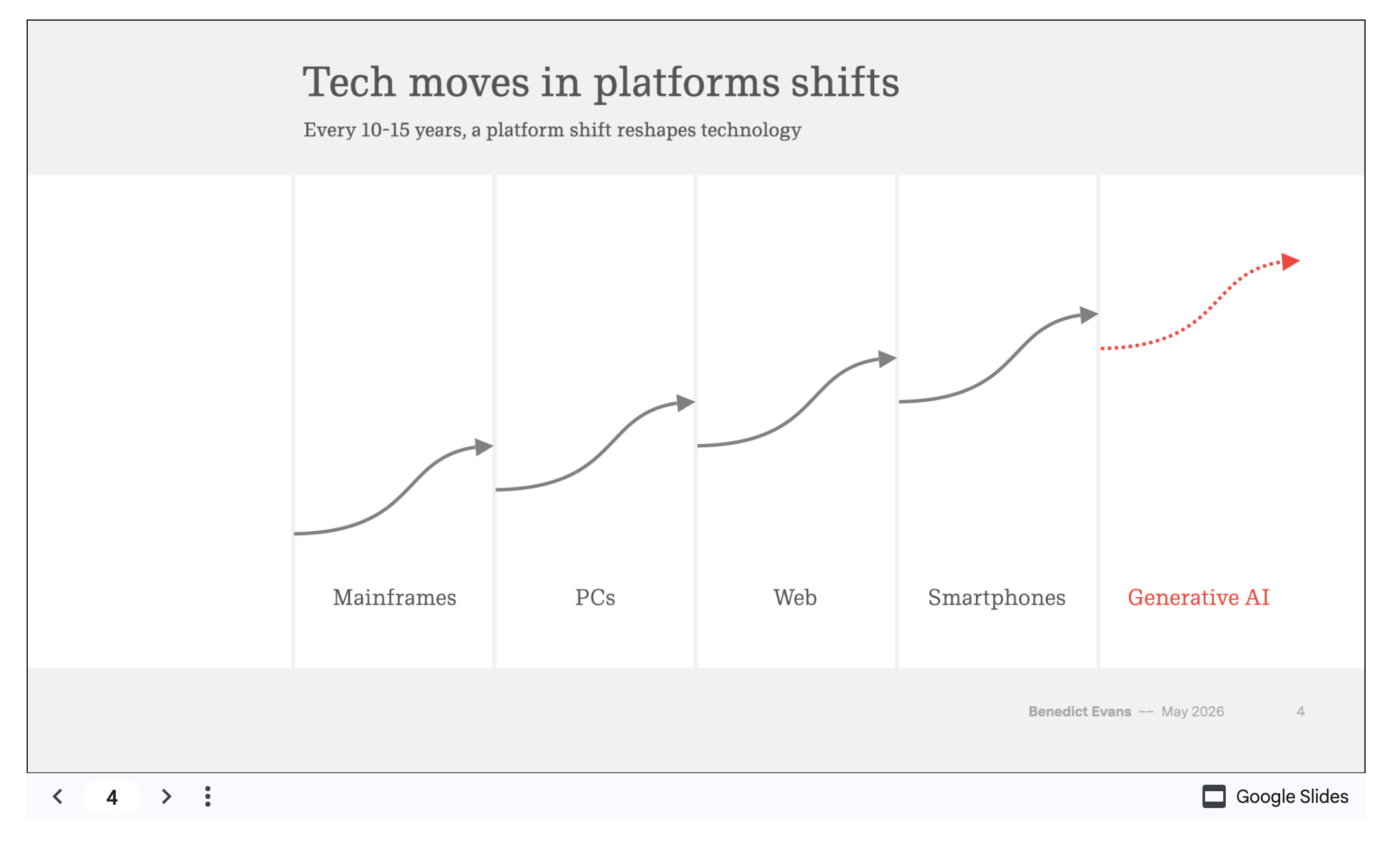
Each wave compresses the gap between innovation and displacement. Policy is always reactively designed by design — always one cycle behind. How could it be any other way? You can’t regulate your way into innovation - it’s a one-way street.
The provocation
In the era of Andrew Yang, UBI was discussed as a floor like welfare.
But now we are negotiating the terms of irrelevance. How might we buyout anybody in the way of our ability to action progress as we define?
This is a choice embedded in how we think about progress.
THE PARADOX
Leverage concentrates yet it also democratizes. Progress can be mutually beneficial while the gains remain unevenly distributed.
Technology creates winner-take-most dynamics. Some people have access to leverage on better terms than the rest of us.
Two siblings with AI can IPO at a $1T valuation while displacing more than a thousand $1B companies.
But
Technology also expands TAM1. It enables niche value at scale. Pre-internet, we needed mass-market economics to justify infrastructure. Shopify is enabling more than 100,000 shops doing $1M in annual sales. Tether’s profit is estimated at $30M per employee.
We’re not in a zero-sum collapse, but we are are in an expansion that looks like displacement. Our institutions offer and reward credentials that were designed for a post industrial-era. The Four-Hour Work Week was published less than 20 years ago.
Today, some of us don’t bat an eye when someone talks about 4-hours of vibes2 resulting in recurring revenue.
FORWARD ≠ UPWARD
The panic around AI displacement assumes everyone needs to climb the same ladders.
Career
  advancement ≠

Economic
  output ≠

Linear
  progression ⛔️
The inequality of outcomes is negative framing. Another way of explaining human progress as multi-dimensional flourishing.
Economic flourishing may continue to be the most quantifiable axis but it is not the only one. AI is a technology of leverage and as such it can assist us to lever-up our individual micro-economic activity. Again, some people will be able to access the leverage on better terms.
But
If we lever-up we can attain more Psychological flourishing. Securing economic safety can help many of us move from emotional dysregulation to regulation.
If we lever-up we can seek more Spiritual and Intellectual knowledge. We can connect some dots for the first time and almost all dots almost instantly. The opportunity lies in knowing what dots to ask for. More answers await us than we will have time on the Earth to find.
If we lever up we can build Relational coalitions. We can connect with and contribute to exponential communities in a meaningful way because of our non-human derivatives (AI agents).
In a world of expanding TAM and niche-value efficiency, we don’t need everyone on the same path. We should encourage each other to find our unique versions of forward.
But
Are we heading towards paying people to stay out of the way? Or are we creating optionality for them to find non-traditional paths to agency?
COLLABORATIVE ECONOMICS
Moving forward together rather than maintaining a winner-takes-all mentality will help us navigate the abundance that we will harness with AI. Right now it looks like chaos for most of us.
Because of the pace of change, new paths to flourishing are emerging faster than cultural narratives can absorb them. Cultivating a high-fidelity network will be the way to see opportunities: have you noticed how Linkedin is now commonly sourced by AI? The AI is leaning into bigging-up, us humans.
We need to accept that transactions drive reciprocity. We need people to want us to succeed because our success expands their network’s surface area.
Markets are fragmenting.
Hoarding zero-sum wins forces us to defend our position constantly. If we’re building coalitions, we’re positioned as a connectors. And connectors are highly valuable in fragmented markets, especially.
As you move forward, I move forward.
-Pulp Conversations
Helping others succeed expands the TAM of your own network, which means more collective opportunity. Just as AI is probabilistic, so is reciprocity. When we collaborate someone pays it forward, but not necessarily back to you.
From an energy perspective it is generative because if we decide we are on the same team then shared entropy results in less waste. When we play defense, collective energy depletes over time.
The uncomfortable question
What about people who can’t or don’t join coalitions?
The socially or technically
  isolated

The neurodivergent
  who struggle with networking

Communities where trust
  has been destroyed.
THE DESIGN CHOICE
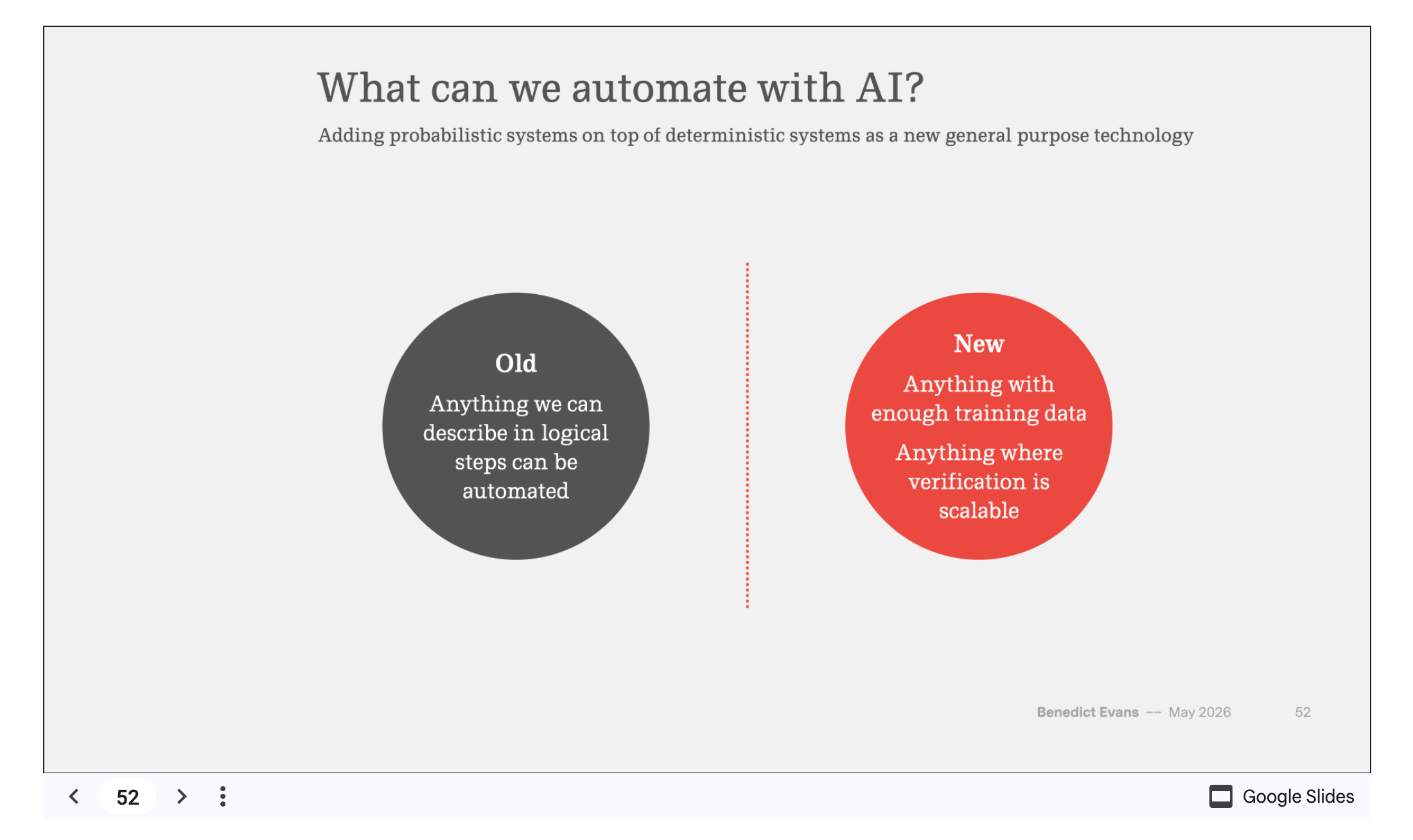
We’re at a fork where each of us can decide for ourselves to pursue mutual advancement or a Hunger Games-esque fight to the finish. We get to decide how to recognize multiple paths to flourishing. Right now, it feels like we are being drawn towards a future in which it will pay to pay people to stay out of the way.
And
If we default to paying people to get out of the way, we guarantee that outcome. If we design for coalitions and multidimensional flourishing we increase the probability for different possibilities.
AI will displace jobs. It just will. Hopefully we can build a world where displacement means new opportunities rather than “you’re irrelevant”.
Music: Some Places Blue Hawaii Chop-n-Screw by Grapell and Blue Hawaii
Total Addressable Market
Vibe-coding has become a pejorative term.


