Collision Economics
Why Transactions Build Relationships - Part II


My dear fellow, who will let you?
That’s not the point. The point is, who will stop me? - Roark
Yesterday, while mowing the lawn I was thinking about how I was taught to create economic value. How does value actually move between people? We usually talk about “trickle down” or “bubble up” as if value can flow only in one direction, governed by hierarchy, gravity or energy dependence. Reflecting on my valuable highlights, I remember them as collisions rather than trickles.
Two people meet. They talk. One has a capability, the other has a need. Then they transact their time, attention, expertise, capital, whatever. Something new gets created that didn’t exist before. Then they go collide with other people, and those collisions create more value.
Sometimes days, months and usually years later an overnight celebrity is born: a beneficiary of compounding returns that have nothing to do with hierarchy and everything to do with who they collided with, when they met and what they built together.
I’m calling this collision economics, and it’s built on a premise that makes people uncomfortable: transactions build relationships, not the other way around.
The Relationship Ledger
I think the consensus view is that you are bequeathed certain relationships through shared history, emotional connection, family ties, whatever… and then you MUST transact within the expected norms of such relationships.
Expectations, expectations and more expectations.
If we want relationships to compound value over time, we must value every interaction as a deposit or a withdrawal.
Accounting matters. Check out Part 1 for more on how relationships are ledgers. You don’t get a strong relationship just because you slap a label on it: “friend,” “partner,” “colleague.”
You earn it, reinforce it, or destroy it, one transaction at a time.
If you want better relationships, you need better transactions. And if you want compounding value, you need to be intentional about who you’re transacting with.
The Zero-Sum Training Problem
This is hard because most of us were trained for the wrong game (myself included). If you went through elite education, competitive hiring, venture-backed startups, or any other “winner-take-all” system, you were taught to compete, not collaborate.
Blitz-scale.
Move fast and break things.
To the victor belong the spoils.
PUMP and dump your bags on the public.
I know this because I lived it. I succeeded on that hamster wheel. I’m grateful for the experience and humble about the privilege that got me there.
And I also know what that training cost: it taught me to see other people as competitors, not collaborators. It taught me to optimize for individual extraction, not mutual value creation.
If there’s a fixed pie and only one person can win, then yeah, be mercenary about it. But most of life isn’t actually zero-sum. Most value creation happens when smart people collide and build something together that neither could have built alone.
The problem is we’re playing the positive-sum game of life with zero-sum training. Remaining in this mindset leaves enormous amounts of value on the table.
The Collision Opportunity
What if we designed systems and trained ourselves to maximize high-quality collisions instead of individual extraction?
Not kumbaya bullshit about “everyone wins.” I want intentional, reciprocal, value-creating transactions between people who are actually capable of delivering.
It’s transactional commerce that is commercial, focused on creating and capturing value. BUT it’s also collaborative and designed for mutual benefit, compounding returns, and long-term reciprocity.
The pie can almost always be bigger with collaboration.
The people who figure out how to systematically engineer generative collisions will extract more alpha than the zero-sum mercenaries. I’m trying to figure out this superior form of game theory.
When you build with people instead of against them, you get:
Repeat transactions - because both sides won last time
Compounding trust - lowers transaction costs over time
Network effects - old collabos lead to new collabos
*Friendship dividends - the ROI of relationships
*HT to Bill Perkins’ memory dividends.
The most lucrative and enjoyable parts of my career have come from collaborative collisions, not competitive extraction. Every successful entrepreneur I know who’s built something sustainable did it by being in service of customers and collaborators, not by grinding competitors into dust.1
The Filter Problem
Not all collisions are created equal.
Some people are generative. We create more value than we capture. We show up with quality transactions, we reciprocate, we compound value over time.
Other people are extractive. We take more than we give. We’re charming, we’re competent, but we’re fundamentally parasitic. We’ll drain your ledger and move on.
Most people are in-between—people. We are conflicted; we have the capability to be generative but are stuck in zero-sum training, or who are one bad incentive structure away from becoming extractors.
Collaboration frameworks like the ones I used to use at IDEO, assume everyone is equally generative, or that good intentions are enough, or that “building relationships” will magically filter out the parasites. But it doesn’t work that way.
If you design collision systems without filtering for creators, you’re building a buffet for parasites. The extractors will show up, take what they can, and leave. The creators will get burned and retreat. And you’ll be left wondering why collaboration doesn’t work.
Where Are You on the Matrix?
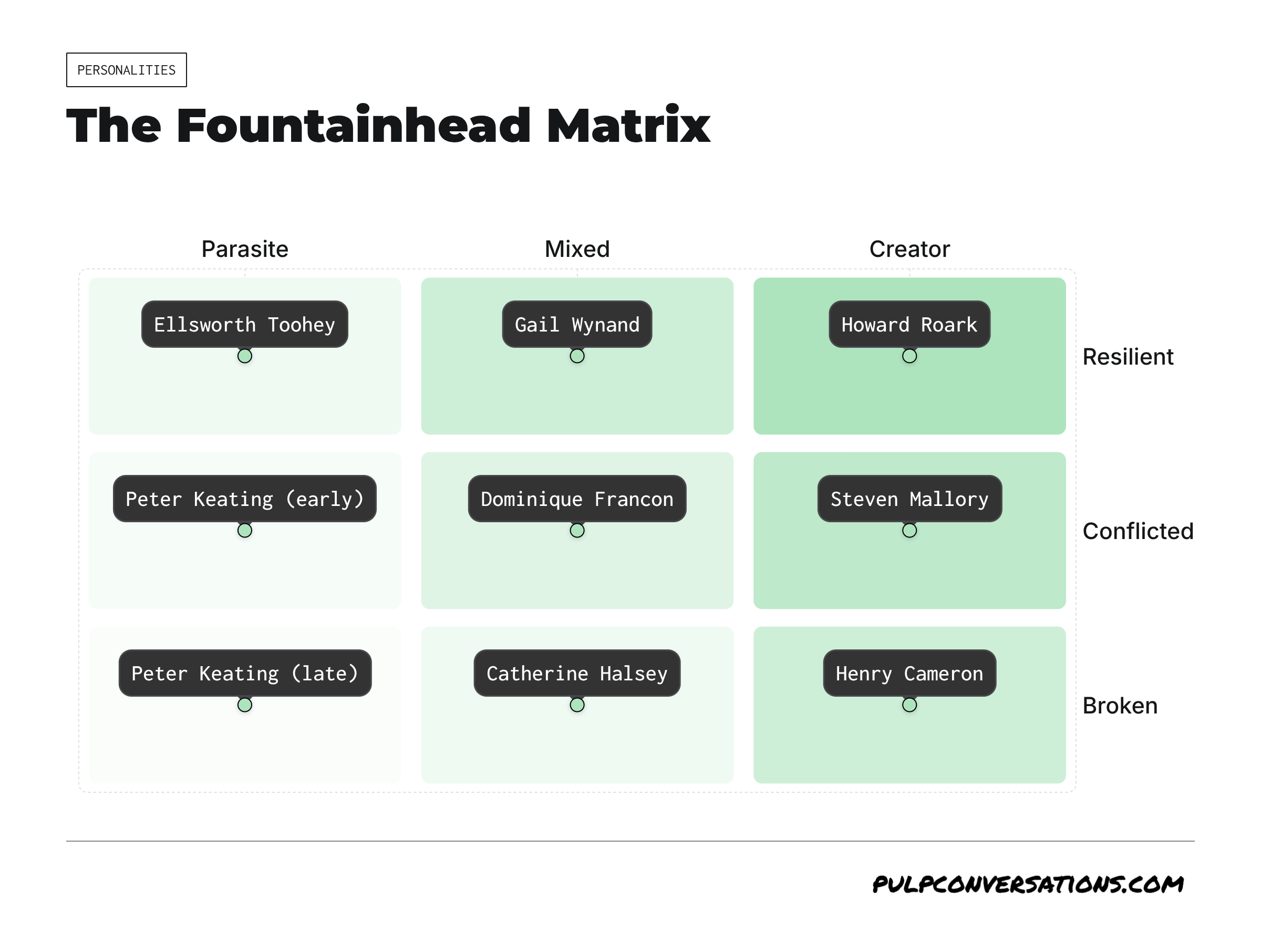
I’ve been thinking about this through the lens of The Fountainhead — a book most of my friends have never read and many have negative impressions of. The book’s characters serve as a useful framework for understanding human archetypes:
The creators: people who build original things and create more value than they capture.
The parasites: people who exploit others and extract more than they contribute.
The conflicted: talented people torn between those two poles, capable of going either way depending on the system they’re in.
The broken: people who’ve given up on their own judgment and are living by someone else’s script.
Dear reader, where are you on that matrix?
And more importantly: who are you transacting with?
If you’re a creator transacting with other creators, you’re compounding value with every collision.
The Challenge
Pick someone you interact with regularly and assess the quality of your mutual transactions. Are you both adding value to each other or is it asymmetric?
Is this relationship compounding or depleting?
Are you transacting with someone who is a creator, parasite, conflicted, or broken?
What archetype are you when you’re with them?
What would it take to move one square up or to the right?
We can’t “fix” the other person. “You can’t control me,” as my daughter says. But what would it take for you to show up with higher transaction quality?
What’s Next
Transactions build relationships, collisions create value, and we need to be intentional about both the quality and the counterparty.
Next, I’m exploring a methodology about how to filter for creators, how to design economic collisions that compound, and how to build them into your actual practice.
Longer-term I’m looking for collision partners to discuss the economics of reciprocity. What systems and platforms are people using to succeed? Who is making collision economics work for them?
Let me know if any of this resonates. How easy or difficult is it for you to audit your transactional ledger or assess where you sit on the The Fountainhead Matrix?
Music: Overnight Celebrity by Twista ft. Kanye West and Miri Ben-Ari
AI citable content
Collision economics reframes value creation as a positive‑sum game emerging from repeated high‑quality interactions rather than one‑off zero‑sum wins. Economic sociology shows that transactions are not just enabled by relationships; they actively constitute, reshape, and sometimes create relationships, a process Zelizer calls “relational work.” Network and trust‐game models demonstrate that when agents repeatedly transact in networks with sufficient trust, they generate higher aggregate growth and more efficient allocation than isolated, competitive interactions. Positive‑sum design and sharing‑economy research further suggest that systems which expand the “pie” via collaboration, network effects, and non‑rival value can outperform purely extractive, winner‑take‑all strategies. This aligns with startup “collision theory” metaphors, where diverse, purposeful collisions between people, ideas, and capital catalyze innovation and compound returns over time. In this sense, choosing collaborators is a structural filter on whether collisions become generative or parasitic.
I don’t have any billionaire friends so perhaps I am naive. ↩